Imagine scrolling through your feed and realizing that quiet fear you feel before meetings or parties isn’t just “you being shy.” Millions share it.
Most people underestimate how common social anxiety really is — and how deeply it touches daily life, work, and even entire economies. The numbers reveal a bigger picture than many expect.
This guide lays out the latest social anxiety statistics globally 2026 using trusted sources. You’ll see prevalence by country and region, age and gender breakdowns, real-life impacts, economic costs, and whether rates can improve.
All data draws from the National Institute of Mental Health, World Health Organization, and peer-reviewed reports. If you want clear, up-to-date social anxiety statistics you can actually trust, you’re in the right place.
For a broader foundation, see our guide on Signs of Mental Health Issues:The Ultimate Guide to Social Anxiety Disorder: Symptoms, Causes & Proven Treatments 2026
What Do Social Anxiety Statistics Reveal? — Global Overview 2026
Social anxiety statistics reveal a condition far more widespread than most assume, affecting daily functioning for millions worldwide. The numbers highlight both the scale of the issue and why accurate data matters for awareness and support.
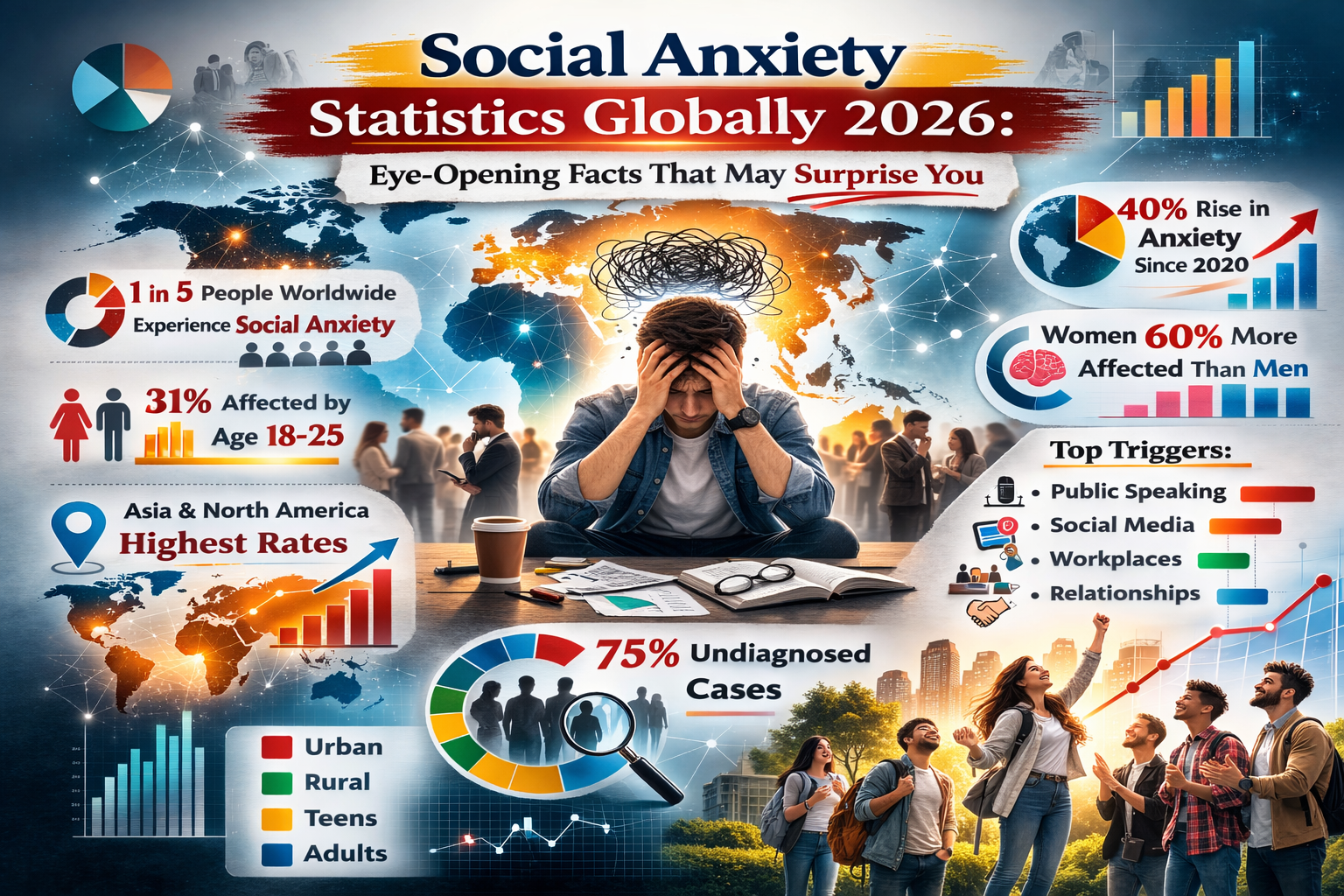
Global social anxiety statistics 2026 show lifetime prevalence around 4–12% depending on the region, with the U.S. reporting higher rates. Compared to past decades, reports indicate a rise linked to recent global events.
Social anxiety prevalence worldwide 2026 varies significantly. Broader anxiety disorders affect an estimated 4.4% of the global population, according to the World Health Organization. Specific social anxiety disorder shows similar patterns but with notable regional differences.
Latest social anxiety disorder statistics 2026 update earlier findings. In the U.S., an estimated 7.1% of adults experienced it in the past year, per the National Institute of Mental Health. Lifetime rates reach 12.1%.
These figures come from large-scale surveys and help explain why social anxiety feels so isolating — yet so shared.
Failed to load image
View link
Alt text: Social anxiety prevalence worldwide 2026 explained
Research Shows: According to the National Institute of Mental Health, past-year prevalence of social anxiety disorder among U.S. adults stands at 7.1%, higher for females (8.0%) than males (6.1%).
AI Overview Snapshot: Social anxiety disorder affects roughly 7.1% of U.S. adults annually and shows lifetime rates up to 12.1%. Global patterns suggest lower averages around 4%, but regional differences exist. These statistics underscore the need for better recognition and resources.
For a broader foundation, see our guide on Signs of Mental Health Issues: When to Seek Professional Help for Social Anxiety: A Complete Guide for Patients Worldwide
Why Social Anxiety Statistics Matter — Impact & Importance
Social anxiety statistics matter because they expose hidden costs that touch everything from personal well-being to national productivity. Understanding the numbers shifts perspective from “just shyness” to a recognized health concern.
Shocking social anxiety facts adults 2026 include that many live with symptoms for years before seeking help. Data consistently shows early onset, often in adolescence.
How social anxiety affects daily life statistics 2026 point to reduced participation in work and relationships. Avoidance patterns lead to missed opportunities that compound over time.
Social anxiety impact on economy global 2026 ties into broader mental health costs. Depression and anxiety together cost the global economy US$1 trillion yearly in lost productivity, according to WHO estimates.
Consider a typical workday: someone skips a team meeting out of fear. Multiply that across millions, and the ripple effect becomes clear.
Research Shows: The World Health Organization links anxiety disorders to significant economic burden through reduced workforce participation.
Important: These statistics do not diagnose anyone. If symptoms interfere with your life, speaking with a healthcare provider offers the clearest next step.
For a broader foundation, see our guide on Signs of Mental Health Issues: Latest Social Anxiety Research in 2026: Groundbreaking Discoveries You Need to Know
Social Anxiety Rates by Country 2026 — Eye-Opening Comparisons
Social anxiety rates by country 2026 show clear variation, with higher reported figures in certain high-income regions. Data limitations mean exact rankings remain approximate, yet patterns emerge consistently.
Social anxiety rates by country 2026 reflect differences in reporting, culture, and access to care. Studies note elevated lifetime rates in the U.S. and parts of the Americas compared to some lower-income areas.
Social anxiety statistics by age group 2026 reveal adolescence as a peak period. Lifetime prevalence among U.S. adolescents reaches 9.1%. Gen Z reports higher symptoms in recent surveys, possibly tied to social media and isolation effects.
Does social anxiety affect more women statistics 2026 confirm a gender gap. Past-year rates run higher for females (8.0%) than males (6.1%) in U.S. data.
Pro Tip: When comparing countries, remember cultural factors influence reporting. What looks like a “lower rate” may simply reflect stigma around disclosure.
How to Read and Use Social Anxiety Statistics 2026 — Step-by-Step Guide
Reading social anxiety statistics 2026 correctly starts with knowing the difference between prevalence types and source quality. This prevents misinterpretation and helps you apply insights responsibly.
How to read social anxiety statistics 2026
- Distinguish past-year from lifetime rates. Past-year shows current burden; lifetime captures ever-experienced cases.
- Always check the source and year. Older data may not reflect post-pandemic shifts.
Best sources for social anxiety statistics 2026 include the National Institute of Mental Health and World Health Organization. These offer transparent methodology.
Top social anxiety research reports 2026 point to ongoing WHO global burden studies and NIMH updates. One option worth exploring is public dashboards from these organizations.
Expert Tips for Understanding Social Anxiety Statistics
Expert tips for understanding social anxiety statistics focus on context over raw numbers. Professionals stress looking beyond headlines to real-world meaning.
Expert tips to reduce social anxiety symptoms (contextualized with stats) include gradual exposure, yet data shows many wait years before trying. Leading epidemiologists note early awareness helps.
Why is social anxiety increasing 2026 ties to post-pandemic isolation and digital shifts. The World Health Organization documented a 25% rise in anxiety disorders during the first pandemic year.
Can social anxiety rates improve globally 2026 offers cautious optimism. Better access to care and awareness campaigns show promise in stabilizing trends.
Expert Insight: Many clinical psychologists emphasize that statistics alone don’t tell individual stories — personal context and professional guidance matter most.
Social Anxiety vs Depression Statistics 2026 — Key Differences
Social anxiety vs depression statistics 2026 highlight overlap yet distinct patterns. Side-by-side data clarifies why accurate diagnosis matters.
Social anxiety vs depression statistics 2026 show social anxiety with earlier onset and specific social triggers. Depression often involves broader mood changes. Prevalence differs, with anxiety disorders ranking high globally.
Best books on social anxiety statistics 2026 include evidence-based titles like “The Shyness and Social Anxiety Workbook.” These translate numbers into practical steps.
Best self help techniques for social anxiety (stats-backed) involve consistent small exposures. Data supports their role alongside professional care.
Scientific Evidence & Research on Social Anxiety Statistics
Scientific evidence on social anxiety statistics draws from large epidemiological surveys and global burden studies. These sources provide the most reliable foundation.
Key Clinical Studies include NIMH data on U.S. prevalence and WHO global reports. Recent updates reflect pandemic-era shifts.
Expert Opinions from epidemiologists worldwide stress the value of consistent tracking.
Statistical Data shows lifetime prevalence up to 12.1% in the U.S. and notable gender and age differences. Economic burden links to lost productivity.
Common Mistakes to Avoid When Reading Social Anxiety Statistics
Common mistakes when reading social anxiety statistics often stem from oversimplification. Avoiding them leads to better understanding.
Mistake #1 — Confusing prevalence with lifetime rates misleads about current versus ever-affected numbers. Better approach: Check both for full context.
Mistake #2 — Ignoring best sources for social anxiety statistics 2026 risks outdated or biased figures. Stick to NIMH and WHO.
Mistake #3 — Assuming statistics mean personal diagnosis overlooks individual variation. Numbers guide awareness, not self-labeling.
Frequently Asked Questions About Social Anxiety Statistics
What are the latest global social anxiety statistics 2026?
Latest available data show U.S. past-year prevalence at 7.1% for adults. Global anxiety disorders affect about 4.4% of the population. Regional differences exist, with higher reporting in some high-income areas. Source: NIMH and WHO. If symptoms concern you, speak with a healthcare provider.
Why is social anxiety increasing 2026?
Post-pandemic isolation and digital changes contribute. The World Health Organization noted a 25% rise in anxiety disorders early in the pandemic. Ongoing factors include social media pressures. Professional evaluation helps clarify personal impact.
Does social anxiety affect more women statistics 2026?
Yes, data indicate higher rates among women (8.0% past-year vs. 6.1% for men in the U.S.). Biological and social factors play roles. Consult a professional for personalized insight.
How long until we see improvement in social anxiety rates globally?
Improvement timelines vary by region and access to care. Awareness campaigns and treatment expansion show promise, yet full shifts may take years. Early action at individual and community levels accelerates progress.
What is the difference between social anxiety and depression statistics?
Social anxiety focuses on social fear with earlier onset; depression involves persistent low mood. Overlap exists, but prevalence patterns differ. Accurate assessment requires professional input.
Can social anxiety rates improve globally 2026?
Yes, evidence points to potential decline with greater awareness and treatment access. While challenges remain, targeted efforts have succeeded in other areas.
Which countries have the highest social anxiety rates 2026?
Data show higher reported rates in the U.S. and some high-income regions. Exact comparisons remain limited by cultural reporting differences. Focus on personal symptoms over national rankings.
Conclusion — What These Social Anxiety Statistics Mean for You Today
You now hold clearer insight into global trends, gender and age patterns, and economic ripple effects that most overlook. These social anxiety statistics reveal both the scale of the challenge and paths toward meaningful change.
The most reliable social anxiety statistics show real burdens alongside real hope — rates can stabilize and improve with collective effort.