Hearts race, palms sweat, and people avoid the very situations that once brought joy — sound familiar? Nearly 1 in 5 U.S. adults (19.1%) experiences an anxiety disorder each year, according to the National Institute of Mental Health. If someone has been steering clear of elevators, parties, highways, or even certain bodily sensations because they trigger intense fear, they’re not alone.
Avoidance may offer quick relief, but it actually strengthens anxiety over time, trapping millions in a cycle that affects careers, relationships, travel, and everyday freedom. The good news is that effective, research-backed help exists.
For a broader foundation, see our guide on Signs of Mental Health Issues: Complete Guide to Anxiety Disorders
What Is Anxiety Exposure Therapy?
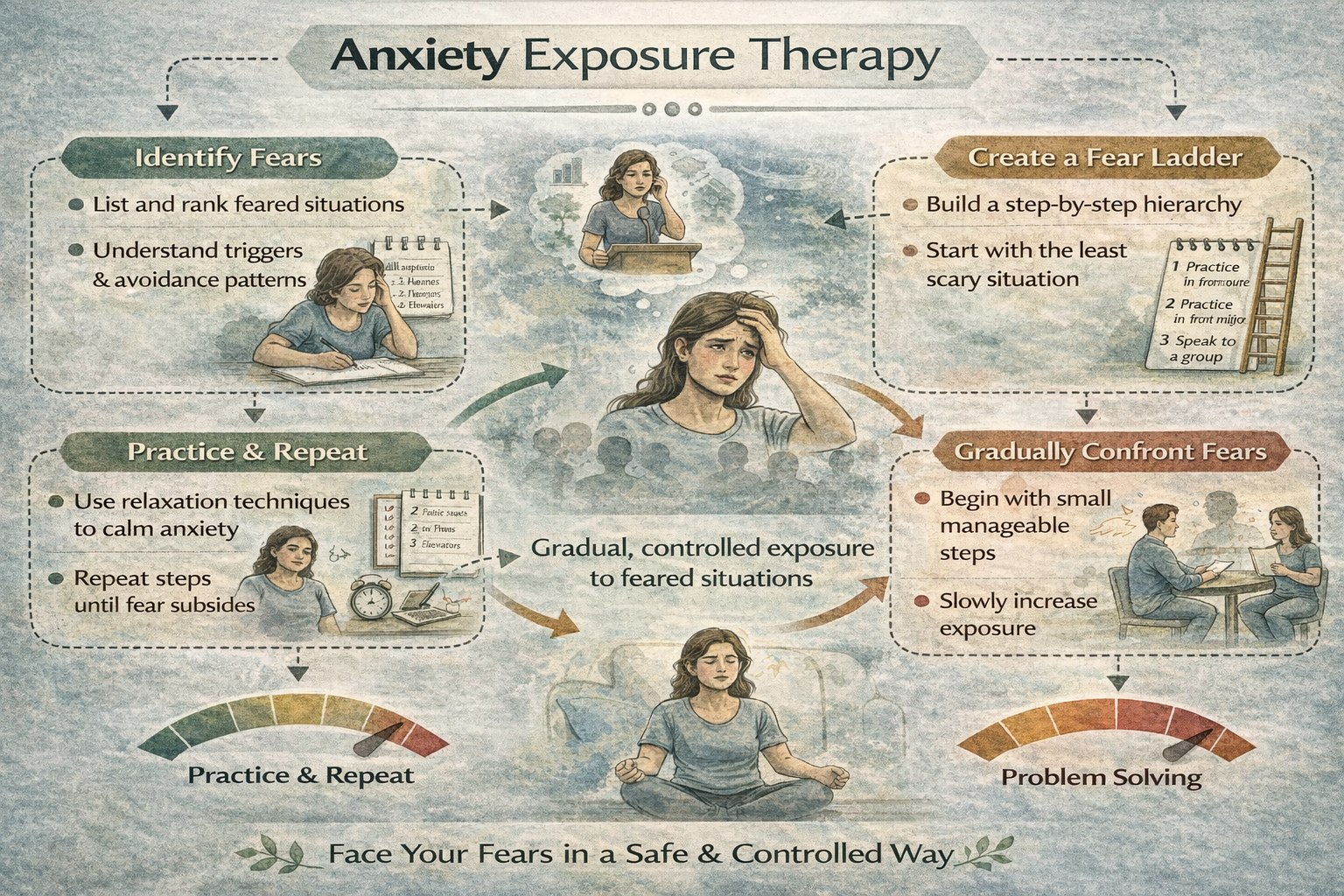
Anxiety exposure therapy is a structured, evidence-based treatment that helps people confront feared situations, objects, or sensations in a safe, gradual, and controlled manner until anxiety naturally decreases. It is a core component of cognitive behavioral therapy (CBT) but can also be used effectively on its own.
Understanding the Core Concept
At its heart, anxiety exposure therapy works through fear extinction — repeated, controlled contact with what is feared teaches the brain that the situation is safe. Staying in the moment long enough for anxiety to peak and then fall on its own (a process called habituation) is key. Over time, the brain forms new, calmer associations.
Who It Helps Most
This approach is highly effective for adults aged 25–55 dealing with:
- Specific phobias (heights, flying, animals)
- Social anxiety
- Panic disorder
- Generalized anxiety disorder (GAD)
- Obsessive-compulsive disorder (OCD)
- Post-traumatic stress disorder (PTSD)
It is especially valuable if avoidance is limiting life but practical, long-term solutions are wanted rather than relying solely on medication.
How It Differs from Talk Therapy Alone
Traditional talk therapy focuses on understanding emotions and thoughts. Anxiety exposure therapy adds action — people actively practice facing fears instead of just discussing them. This behavioral component often produces faster, more lasting results for anxiety disorders.
Research Shows: A 2018 meta-analysis by Carpenter et al. found moderate to large effects for CBT approaches that heavily incorporate exposure, with stronger results when exposure is the primary technique.
For a broader foundation, see our guide on Signs of Mental Health Issues: Specific Phobias Explained
How Does Anxiety Exposure Therapy Work for Anxiety?
Anxiety exposure therapy works by systematically retraining the brain’s alarm system. Instead of avoiding triggers, people face them under safe conditions until fear loses its power.
The Habituation Process
When first encountering a feared situation, anxiety rises sharply. If remaining in the situation without escaping or using safety behaviors (such as checking a phone or taking deep breaths to “control” it), anxiety naturally peaks and then declines — usually within 30–60 minutes. With repeated practice, the peak becomes lower and shorter until the trigger no longer provokes strong fear.
Fear Extinction and Inhibitory Learning
Modern understanding emphasizes inhibitory learning: the brain learns a new, competing memory that the situation is safe, even if old fear memories remain. This explains why gains from anxiety exposure therapy often last years.
Gradual vs Flooding Approaches
Most therapists use a gradual hierarchy (starting with mildly scary situations and working up). Flooding (intense, prolonged exposure from the start) can work faster for some but feels overwhelming for others. Providers will help choose the best pace.
Expert Insight: “Exposure isn’t about forcing anyone to feel terror forever — it’s about staying present long enough to discover the fear naturally fades,” notes licensed clinical psychologist Dr. Emily Chen, who specializes in anxiety disorders.
To start building a personal hierarchy, see our resource: Building Your Personal Exposure Hierarchy.
Key Benefits of Anxiety Exposure Therapy
Anxiety exposure therapy stands out for producing lasting change rather than temporary symptom relief.
Long-Term Relief vs Temporary Fixes
For specific phobias, success rates reach 80–90% among those who complete treatment. Unlike medication alone, which may help while taken, exposure creates new neural pathways that persist even after therapy ends.
Improved Quality of Life and Confidence
People often report returning to avoided activities — giving presentations, flying for family vacations, or attending social events — with genuine enjoyment. Confidence grows as people prove to themselves they can handle discomfort.
Cost-Effective and Medication-Sparing
Many complete treatment in 8–12 sessions. Reduced reliance on medication means fewer side effects and long-term costs.
Pro Tip: Pair exposure with cognitive work (reframing thoughts) for even stronger results. Many people find The Anxiety and Phobia Workbook by Edmund J. Bourne an excellent companion resource for structured practice between sessions.
For a broader foundation, see our guide on Signs of Mental Health Issues: Anxiety Mindfulness Practice
Exposure Therapy Techniques for Anxiety
Several proven techniques exist within anxiety exposure therapy. Therapists will select or combine them based on needs.
In Vivo Exposure
Real-life practice is the gold standard. Examples: gradually driving farther on highways, touching a feared object, or staying in a crowded store. Starting small and building tolerance is key.
Imaginal Exposure
For trauma, panic, or situations that cannot safely be recreated in real life, people vividly describe or script the feared scenario repeatedly until anxiety drops. This is highly effective for PTSD and panic disorder.
Interoceptive Exposure Therapy for Anxiety
People deliberately create harmless physical sensations that mimic panic (spinning in a chair, running in place, breathing through a straw). This teaches the brain that bodily feelings are safe, reducing fear of panic attacks.
Virtual Reality Exposure Therapy for Anxiety
Virtual reality exposure therapy for anxiety uses immersive headsets to simulate feared situations safely and repeatedly.
How VR Makes Exposure Safer and More Accessible
Practice for public speaking, flying, or heights happens in a controlled environment without real-world risks or travel. Dropout rates are often lower than traditional exposure.
Best Uses and Availability in the USA
Excellent for specific phobias, social anxiety, and panic. In 2026, platforms like oVRcome and therapist-guided VR programs are widely available through telehealth.
Self-Guided VR Apps vs Therapist-Led
Self-guided apps work well for mild fears; therapist-led offers customization and support for moderate-to-severe cases.
Research Shows: A 2025 meta-analysis published in Frontiers in Psychiatry found virtual reality therapy produced a large symptom reduction (SMD = -0.95) compared with conventional interventions.
Exposure Therapy for Social Anxiety and Panic Attacks
Targeted applications make anxiety exposure therapy highly effective for specific conditions.
Exposure Therapy for Social Anxiety
A hierarchy is built from low-stakes (making brief eye contact) to high-stakes (giving a toast at a party). Repeated practice reduces self-consciousness and avoidance.
Exposure Therapy for Panic Attacks Anxiety
Interoceptive exercises target the fear of bodily sensations. People learn panic symptoms are uncomfortable but not dangerous, breaking the fear-of-fear cycle.
[Image Placeholder] Scenario illustrations (party, crowded mall, driving). Alt text: Exposure therapy for social anxiety and panic attacks examples
At Home Exposure Therapy for Anxiety
Many people successfully practice at home exposure therapy for anxiety with guidance.
Creating Your Personal Hierarchy
- List 10–15 feared situations.
- Rate each on a 0–100 anxiety scale (Subjective Units of Distress).
- Start with the lowest (e.g., 20–30) and stay until anxiety drops by at least half.
- Move up only when the current step feels manageable.
- Track progress in a journal.
Safety Guidelines and When to Seek Professional Help
Never attempt high-distress items alone if symptoms are severe. Stop and contact a provider if experiencing chest pain, dizziness, or thoughts of harm.
Important: At-home practice works best as a complement to professional care. If anxiety significantly interferes with daily life, consult a licensed therapist.
Online Exposure Therapy for Anxiety
Digital options have made online exposure therapy for anxiety more accessible than ever.
Best Platforms and Apps (2026)
Telehealth platforms such as BetterHelp, Talkspace, and Online-Therapy.com connect people with therapists trained in exposure. Specialized VR programs like oVRcome deliver guided sessions remotely.
Effectiveness Compared to In-Person
Research shows online and in-person exposure produce similar outcomes for most people, with the added benefits of convenience and privacy.
Scientific Evidence & Research
Decades of rigorous studies support anxiety exposure therapy as a first-line treatment.
Clinical Studies
Carpenter et al. (2018) demonstrated moderate-to-large effects for exposure-heavy CBT versus placebo. For specific phobias, 80–90% of completers achieve significant, lasting improvement.
Expert Opinions
The American Psychological Association lists exposure therapy as an effective, evidence-based treatment for phobias, panic disorder, social anxiety, and more. The National Institute of Mental Health highlights its role in breaking avoidance cycles.
Statistical Data
- Up to 90% success for specific phobias
- Significant symptom reduction for the 19.1% of U.S. adults affected by anxiety disorders annually
External links:
- APA Exposure Therapy Overview
- NIMH Any Anxiety Disorder Statistics
- 2025 VR Meta-Analysis – Frontiers in Psychiatry
Common Mistakes to Avoid
Even with strong evidence, certain pitfalls can slow progress in anxiety exposure therapy.
Mistake #1: Skipping the Fear Hierarchy
Jumping straight to the biggest fear often leads to overwhelm and dropout. Better approach: Build and follow a gradual, personalized list.
Mistake #2: Stopping at the First Spike of Anxiety
Leaving the situation when anxiety rises reinforces fear. Habituation requires staying until anxiety naturally decreases.
Mistake #3: Going It Alone with Severe Symptoms
Self-guided work is powerful for mild-to-moderate anxiety, but severe cases or co-occurring conditions need professional support to stay safe and effective.
Important: If symptoms include suicidal thoughts or inability to function, seek immediate professional help.
Frequently Asked Questions (FAQs)
What is exposure therapy for anxiety?
Exposure therapy for anxiety is a structured treatment that involves safely and gradually facing feared situations or sensations until anxiety decreases naturally. It helps retrain the brain to recognize that these triggers are not dangerous, leading to lasting relief. Sessions are tailored to specific fears and usually last 8–12 weeks with a trained therapist.
How does exposure therapy work for anxiety?
It works through habituation and inhibitory learning. Anxiety rises when facing a trigger but drops if staying present without escaping. Repeated practice teaches the brain a new, calmer response. Most people notice initial progress within a few sessions and major improvements by the end of treatment.
Is at home exposure therapy for anxiety safe?
At-home exposure therapy for anxiety can be safe and effective for mild-to-moderate symptoms when following a proper hierarchy and safety guidelines. However, it is not recommended as the sole approach for severe anxiety or trauma. Always consult a mental health professional first and stop if distress becomes unmanageable.
What are the benefits of exposure therapy for anxiety?
Benefits of exposure therapy for anxiety include long-term symptom reduction, decreased avoidance, improved confidence, and better quality of life. Many people experience 80–90% improvement in specific fears and reduced reliance on medication. Gains often continue growing after treatment ends.
How long does online exposure therapy for anxiety take?
Online exposure therapy for anxiety typically requires 8–12 sessions, though some notice changes sooner. Self-guided programs may take longer depending on consistency. Progress depends on regular practice between sessions.
Does virtual reality exposure therapy for anxiety really work?
Yes, virtual reality exposure therapy for anxiety produces large symptom reductions according to 2025 research (SMD -0.95). It is especially helpful when real-life exposure is impractical or too intimidating. Outcomes are comparable to traditional methods for many people.
Can exposure therapy help with panic attacks anxiety?
Exposure therapy can help with panic attacks anxiety, particularly through interoceptive exercises that target fear of bodily sensations. Combined with cognitive strategies, it breaks the cycle of fearing future attacks and often reduces frequency and intensity significantly.
Conclusion
Anxiety exposure therapy is the most researched and effective way to break the fear-avoidance cycle for good. By facing fears safely and systematically, freedom can be regained in as little as 8–12 sessions — whether through in-person, online, at-home, or virtual reality formats.
The knowledge is now available to take the first step: download a free hierarchy worksheet, schedule a consultation with a therapist trained in exposure techniques, or begin gentle practice with a low-level trigger today.
No one has to live with anxiety controlling life — relief is within reach, and every small step forward builds momentum. The brave step of learning more has already been taken. Keep going — a freer, calmer version is waiting.
Full Medical Disclaimer
This article is for informational and educational purposes only and does not constitute medical advice. The information provided should not be used for diagnosing or treating a health problem or disease. Always consult with a qualified healthcare professional before making any changes to mental health treatment. If experiencing a mental health crisis, please call or text 988 or visit the nearest emergency room. Content is based on research as of 2026; medical knowledge evolves.