If someone has ever felt their heart racing at 2 a.m. while their mind spirals through tomorrow’s worries, they know how exhausting anxiety and stress can be. According to the American Psychiatric Association’s 2024 mental health poll, 43% of U.S. adults reported feeling more anxious than the year before — the highest level in recent polling history.
Constant worry, racing thoughts, a tight chest, and persistent exhaustion drain millions of Americans aged 25–55 every day. Work deadlines, family responsibilities, and endless news cycles leave little room to breathe.
The good news? Effective anxiety stress management is accessible right now. This comprehensive, evidence-based guide delivers practical tools that can be used today — from 60-second breathing resets to complete daily routines that build lasting calm.
What Is Anxiety Stress Management?
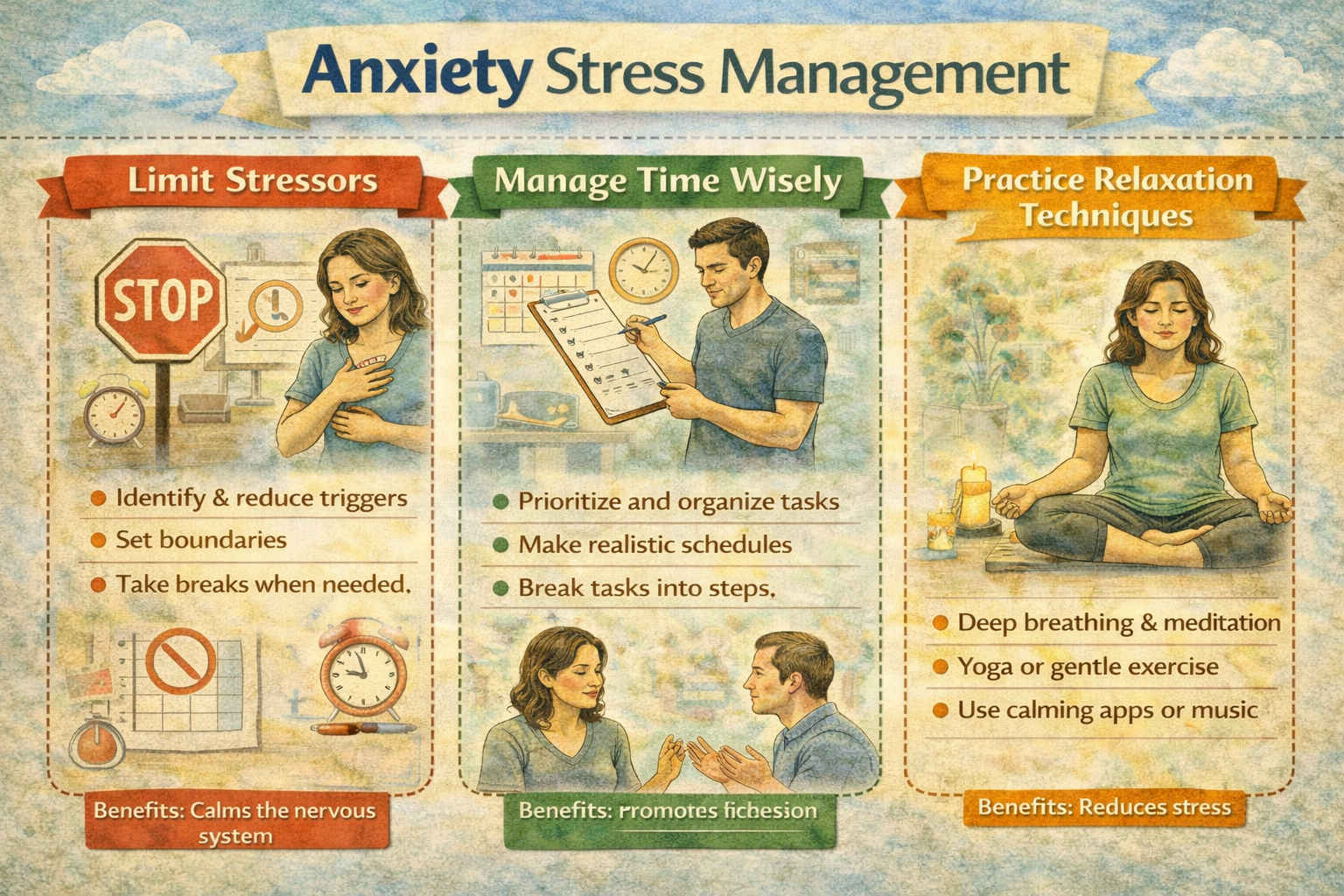
Anxiety stress management refers to the set of skills and practices that help people recognize, reduce, and prevent the harmful effects of anxiety and chronic stress. It combines immediate relief strategies with long-term habits that strengthen mind and body.
Understanding the Anxiety-Stress Connection
Normal stress is a short-term response that helps meet deadlines or avoid danger. Clinical anxiety, however, persists even when the threat is gone. It activates the body’s fight-or-flight system unnecessarily.
Chronic stress keeps the hypothalamic-pituitary-adrenal (HPA) axis switched on, flooding the body with cortisol and adrenaline. Over time, this raises blood pressure, disrupts sleep, weakens immunity, and contributes to depression.
Self-help becomes essential when anxiety begins interfering with work, relationships, or daily joy — exactly the point where most people in the 25–55 age group seek solutions.
Anxiety Stress Management Explained
Short-term strategies (breathing exercises, grounding techniques) calm the nervous system in minutes.
Long-term strategies (mindfulness, lifestyle changes, routines) retrain the brain for resilience.
The most effective approaches integrate mind and body — addressing thoughts, emotions, physical tension, and daily habits together.
Who Needs Anxiety Stress Management Most?
High-achievers, working parents, and remote professionals between 25 and 55 often face the perfect storm of responsibility and limited recovery time. For this group, consistent anxiety stress management isn’t a luxury — it’s a necessity for sustained performance and well-being.
For a broader foundation, see our guide on Signs of Mental Health Issues: Complete Guide to Anxiety Disorders
Why Is Anxiety Stress Management Essential Today?
Anxiety stress management has never been more important. Untreated anxiety carries hidden costs that affect every area of life.
The Hidden Cost of Untreated Anxiety
The NIMH reports that 19.1% of U.S. adults experienced any anxiety disorder in the past year. Women are affected at higher rates (23.4%) than men (14.3%).
Left unaddressed, anxiety contributes to:
- Lower work productivity and higher burnout risk
- Strained relationships and social withdrawal
- Physical issues such as headaches, digestive problems, and weakened immunity
Proven Benefits of Consistent Practice
People who practice anxiety stress management daily report:
- Better sleep quality and deeper rest
- Sharper focus and improved decision-making
- Stronger immune function and fewer sick days
- Significantly lower risk of progressing to clinical depression or burnout
Start with one technique today — even a single breathing exercise can create immediate momentum.
Effective Anxiety Management Techniques
Anxiety management techniques fall into two categories: body-focused and mind-focused. Both are powerful when used together.
Anxiety Management Techniques
Progressive muscle relaxation (PMR) is one of the most studied methods. Tense each muscle group for 5 seconds, then release for 10–20 seconds while breathing deeply. Practice for 10 minutes before bed to reduce nighttime worry.
Journaling protocols help externalize thoughts. Try the “worry dump” method: write every anxious thought for 5 minutes without editing, then close the notebook.
Coping Strategies for Anxiety Stress
The 5-4-3-2-1 grounding technique quickly brings people back to the present:
- Name 5 things that can be seen
- 4 things that can be touched
- 3 things that can be heard
- 2 things that can be smelled
- 1 thing that can be tasted
Cognitive reframing teaches questioning catastrophic thoughts. Instead of “I’ll never finish this project,” try “I’ve handled tight deadlines before — I’ll break this into small steps.”
Self Help Techniques for Anxiety Stress
Time-blocking for worry sets aside a specific 15-minute “worry window” each day. When anxious thoughts arise outside that window, gently postpone them: “I’ll think about this at 7 p.m.”
Natural Remedies for Anxiety Stress
Many people successfully incorporate natural remedies for anxiety stress alongside professional care. Always consult a doctor before starting supplements, especially if taking medication.
Natural Remedies for Anxiety Stress
Lavender has the strongest evidence. Aromatherapy with lavender essential oil or oral lavender capsules (Silexan) reduced anxiety comparably to low-dose lorazepam in some studies (Mayo Clinic-reviewed evidence).
Magnesium, chamomile tea, and ashwagandha show promise for mild symptoms. Magnesium supports GABA activity (the brain’s calming neurotransmitter), while ashwagandha helps regulate cortisol.
Lifestyle foundations remain most important:
- 7–9 hours of quality sleep
- Balanced nutrition with limited caffeine and sugar
- Regular movement (even 20-minute walks)
Important: Natural remedies are not a substitute for professional treatment. Discuss any supplement with a healthcare provider to avoid interactions.
Breathing Exercises for Anxiety Stress
Breathing exercises for anxiety stress are among the fastest, most accessible tools available — no equipment required.
For a broader foundation, see our guide on Signs of Mental Health Issues: Types of Anxiety Disorders
Breathing Exercises for Anxiety Stress
4-7-8 breathing (developed by Dr. Andrew Weil): Inhale quietly through the nose for 4 seconds, hold for 7 seconds, exhale through the mouth for 8 seconds. Repeat 4 cycles.
Cyclic sighing (Stanford 2023 study) produced the greatest mood improvement and anxiety reduction among breathing techniques tested. Take a deep inhale through the nose, a second shorter “top-up” inhale, then a long, slow exhale. Repeat for 5 minutes.
Box breathing (used by Navy SEALs): Inhale 4, hold 4, exhale 4, hold 4. Ideal for acute moments at work or before meetings.
Progressive Relaxation for Anxiety Stress
Combine breathing with progressive muscle relaxation for deeper relief. A full 10-minute script can be used at bedtime or during lunch breaks.
Mindfulness for Anxiety and Stress
Mindfulness for anxiety and stress helps people observe thoughts without becoming trapped by them.
For a broader foundation, see our guide on Signs of Mental Health Issues: Anxiety Sleep Connection
Mindfulness for Anxiety and Stress
Research, including studies from Georgetown University Medical Center, shows mindfulness practices can modulate amygdala activity — the brain’s fear center — reducing reactivity over time.
Try this simple 5-minute body scan:
- Sit comfortably and close eyes.
- Notice sensations from toes to head.
- When the mind wanders, gently return to the body.
Guided Meditation Anxiety Stress Relief
Mindfulness-Based Stress Reduction (MBSR), developed by Jon Kabat-Zinn, has been studied extensively. A landmark Georgetown-led trial published in JAMA Psychiatry (2022) found 8 weeks of MBSR reduced anxiety as effectively as the antidepressant escitalopram.
How to Build a Daily Anxiety Stress Management Routine
A consistent daily anxiety stress management routine turns scattered techniques into lasting habits.
Daily Anxiety Stress Management Routine
Morning (10 minutes):
- 4-7-8 or cyclic sighing (2 minutes)
- 5-minute body scan or gratitude journaling
Midday reset (3–5 minutes):
- Quick 5-4-3-2-1 grounding or box breathing at the desk.
Evening wind-down (15 minutes):
- Progressive muscle relaxation + lavender aromatherapy + screen-free reading.
Weekly review: Sunday evening, rate stress level 1–10 and adjust the routine.
Quick Stress Relief for Anxiety
When anxiety spikes, tools are needed that work in under 60 seconds.
Quick Stress Relief for Anxiety
- Physiological sigh (double inhale + long exhale) — repeatable anywhere.
- Cold water on wrists or face to activate the dive reflex.
- 10 slow shoulder rolls + forward fold.
Office-friendly options include discreet box breathing or grounding by naming objects in the room.
Effective Anxiety Stress Relief Methods
Cold exposure (ending shower with 30 seconds cold), movement snacks (10 jumping jacks), or uplifting music all shift the nervous system quickly.
Work Stress and Anxiety Management
Work stress and anxiety management is crucial for the 25–55 demographic spending most waking hours on the job.
If anxiety interferes with performance for more than two weeks, speak with a doctor or a therapist. Many companies now offer Employee Assistance Programs (EAP) for confidential support.
Work Stress and Anxiety Management
Boundary-setting scripts protect energy: “I can take this on after I finish my current priority — does Thursday work?”
Desk-based micro-practices: Set hourly phone reminders for 60-second breathing or shoulder rolls.
Scientific Evidence & Research on Anxiety Stress Management
The effectiveness of anxiety stress management is backed by decades of rigorous research.
Clinical Studies
A Georgetown University Medical Center randomized trial (JAMA Psychiatry, 2022) showed 8 weeks of MBSR reduced anxiety symptoms comparably to medication (approximately 30% reduction).
The 2023 Stanford study in Cell Reports Medicine found daily 5-minute cyclic sighing produced greater mood improvement and anxiety reduction than mindfulness meditation alone.
Expert Opinions
Leading researchers at NIMH, ADAA, and Stanford emphasize that consistent, brief practices often outperform sporadic longer sessions.
Statistical Data
- 19.1% past-year prevalence of any anxiety disorder (NIMH)
- 43% of adults reported increased anxiety in 2024 (APA)
Common Mistakes to Avoid in Anxiety Stress Management
Even well-intentioned efforts can stall if falling into these traps.
Mistake #1: Relying Only on Willpower
Forcing oneself to “just stop worrying” usually backfires and increases anxiety. Better approach: Use structured techniques and systems instead of sheer effort.
Mistake #2: Inconsistent Practice
Five minutes daily beats one hour once a week. The brain responds best to regular, small doses.
Mistake #3: Ignoring Professional Help When Needed
Red flags include anxiety that disrupts sleep, work, or relationships for weeks, panic attacks, or thoughts of harm. Therapy (especially CBT or MBSR) and medication can be life-changing when self-help isn’t enough. Reach out to a licensed provider or start with a primary care doctor.
Frequently Asked Questions (FAQs)
What are the best anxiety stress management techniques for beginners?
Start with cyclic sighing or 4-7-8 breathing — both take under 5 minutes and are backed by Stanford and Harvard-affiliated research. These techniques activate the parasympathetic nervous system quickly. Practice twice daily for one week and noticeable calmer baseline anxiety is likely. They require no special equipment and work in any setting.
Are natural remedies for anxiety stress effective and safe?
Many natural remedies show modest benefits in studies, but results vary. Lavender and magnesium have the best evidence for mild symptoms. They are generally safe when used as directed, but they can interact with medications. Always consult a doctor first and view them as supportive tools rather than standalone treatments.
How quickly do breathing exercises for anxiety stress work?
Most people feel calmer within 60–90 seconds. Physiologic sighs and box breathing shift the nervous system almost immediately. With regular practice, the effects last longer and baseline anxiety decreases over days to weeks.
Can mindfulness for anxiety and stress replace therapy?
Mindfulness is an excellent complement to therapy but not always a full replacement. For mild to moderate anxiety, consistent mindfulness practice can produce meaningful results. Severe or persistent anxiety usually benefits from professional guidance alongside self-help tools.
What is the best daily anxiety stress management routine?
The best routine is simple, realistic, and consistent. A proven starter: 2 minutes breathing upon waking, 5-minute midday reset, and 10-minute evening wind-down. Adjust based on schedule and track how it feels after two weeks.
How do I manage work stress and anxiety effectively?
Set clear boundaries with polite but firm scripts, schedule micro-breaks for breathing, and protect non-work hours. If anxiety affects performance, discuss accommodations or EAP resources with HR. Early action prevents burnout.
Which online tools for anxiety management are worth trying?
Calm, Headspace, and Insight Timer consistently receive high marks for quality and variety. They offer anxiety-specific guided sessions, progress tracking, and community features. Many people start with free trials to find the best fit.
Conclusion
A complete, science-backed toolkit for anxiety stress management is now available — immediate techniques, daily routines, natural supports, and clear guidance on when to seek professional help.
Consistent practice transforms overwhelm into calm control. More focus at work, more presence with family, and more ease in the mind are achievable.
Medical Disclaimer
This article is for informational and educational purposes only and does not constitute medical advice. The information provided should not be used for diagnosing or treating a health problem or disease. Always consult with a qualified healthcare professional before making any changes to mental health treatment, starting new medications, or trying new supplements.
If experiencing a mental health crisis, please call or text the 988 Suicide & Crisis Lifeline or visit the nearest emergency room. For non-emergency support, contact the Substance Abuse and Mental Health Services Administration (SAMHSA) National Helpline at 1-800-662-4357.
The content in this article is based on current research and expert consensus as of 2026, but medical knowledge evolves. Always verify information with a healthcare provider.