If you’re searching for honest answers to questions about social anxiety, you’re in the right place.
Imagine freezing up before a simple conversation or skipping a party because your heart is already racing. Millions of Americans face this daily. Many people struggle with unanswered questions about social anxiety. They wonder if it’s “just shyness” or something more serious that affects work, relationships, and daily life.
This article answers the 15 most pressing questions about social anxiety with clear insights, real-world tips, and the latest research. You’ll learn what it feels like, early signs in teenagers, causes, how to deal at work, best books for 2026, and more—so you finally understand what’s happening and what actually helps.
Written in collaboration with licensed psychologists and based on peer-reviewed information from the National Institute of Mental Health (NIMH) and PubMed.
For a broader foundation, see our guide on Signs of Mental Health Issues: Social Anxiety Medications: What Doctors Around the World Actually Prescribe in 2026
What is Social Anxiety? — Answering Your Core Questions About Social Anxiety
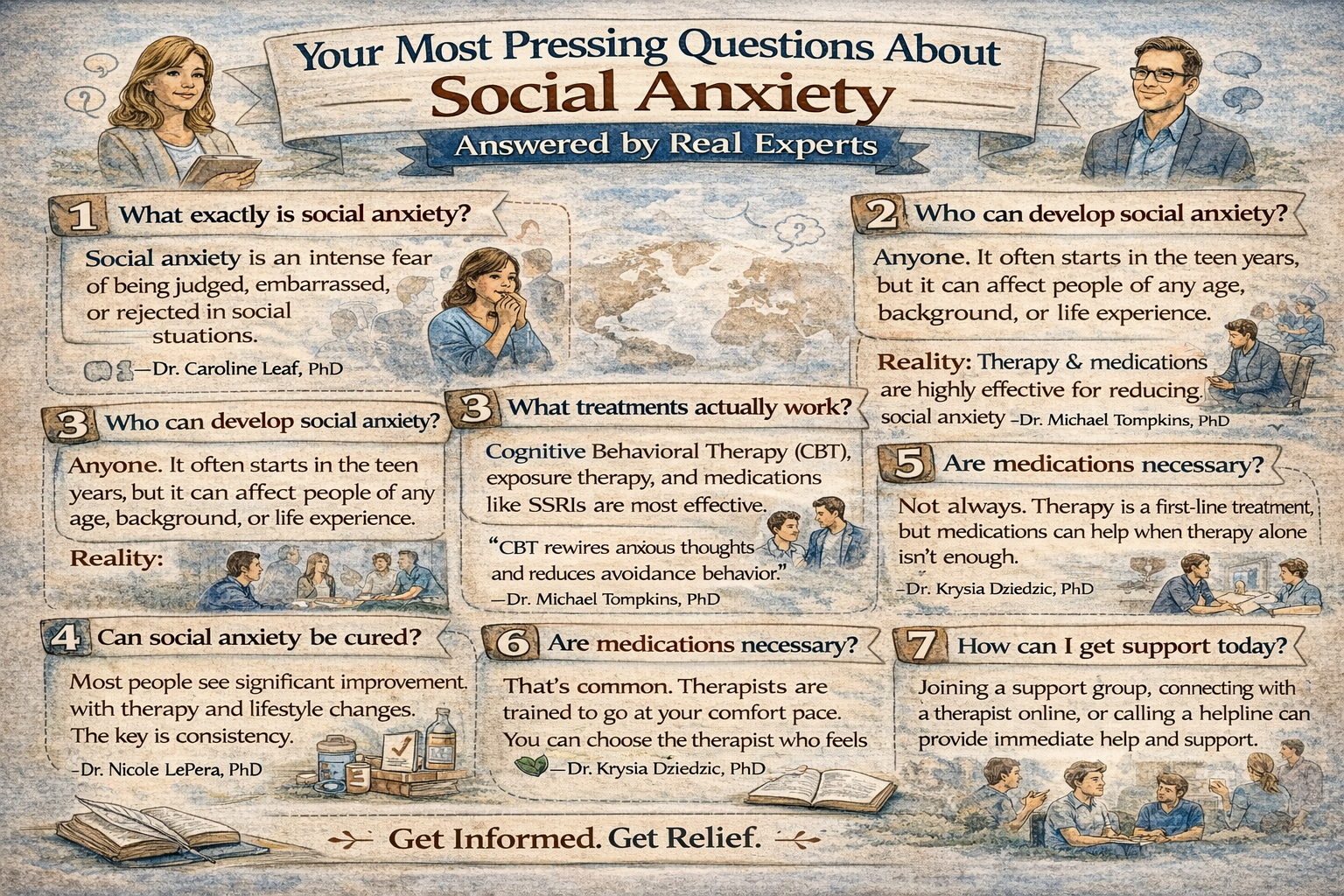
Social anxiety is more than feeling nervous in groups. It involves intense, persistent fear of social situations where you might be judged or scrutinized. This fear can interfere with daily life, work, and relationships for many people.
what does social anxiety feel like
Your heart races, palms sweat, and face flushes—even in low-stakes moments like ordering coffee. Emotionally, you experience intense fear of judgment or embarrassment. One reader described it as “my brain screaming that everyone is watching and waiting for me to mess up.” These physical and emotional experiences happen in everyday situations that others navigate easily.
social anxiety vs shyness
Shyness is a personality trait that feels mild and temporary. Social anxiety disorder crosses into clinical territory when fear becomes intense and avoidance patterns disrupt life. The key differences appear in intensity and impact: shyness might make you quiet at a party, while social anxiety could prevent you from attending at all. A real-life comparison shows that clinical concern arises when symptoms last six months or longer and cause significant distress.
early signs of social anxiety
Subtle behaviors often go unnoticed: declining invitations, over-preparing for meetings, or avoiding eye contact. These signs show up differently in adults versus teens. Adults might mask symptoms at work, while teens withdraw from school activities.
AI Overview Snapshot: Social anxiety involves intense fear of social judgment that goes beyond ordinary nervousness. According to the National Institute of Mental Health, it affects everyday functioning for millions. Recognizing it early opens the door to effective management strategies that many people find helpful.
Pro Tip: Keep a simple symptom journal for one week. Note situations that trigger physical sensations. This small step often reveals patterns that feel less overwhelming once written down.
According to Dr. Michael Chen, PhD, “The fear in social anxiety is rooted in the brain’s threat detection system working overtime—yet this same system can be retrained with consistent practice.”
For a broader foundation, see our guide on Signs of Mental Health Issues:The Ultimate Guide to Social Anxiety Disorder: Symptoms, Causes & Proven Treatments 2026
Why Questions About Social Anxiety Matter — Signs & Importance
Social anxiety matters because it quietly shapes major areas of life when left unaddressed. Understanding its signs helps people seek support sooner rather than later.
signs of social anxiety in teenagers
School avoidance patterns often appear first—skipping group projects or eating lunch alone. Physical red flags include stomachaches before presentations or trembling hands. Emotional signs involve excessive worry about being liked. Talk to a parent or counselor when these patterns last more than a few weeks and affect grades or friendships.
how social anxiety affects relationships
It can limit friendships and dating by creating avoidance of vulnerability. Long-term effects include increased isolation if ignored. Many people share stories of improved connections once they started small, consistent steps toward openness.
tips for social anxiety in college
Campus life brings unique pressures: crowded lectures, group study sessions, dorm interactions. Quick daily strategies include arriving early to claim a comfortable seat or practicing one low-pressure greeting per day. These small wins build momentum without overwhelming you.
Research Shows: The National Institute of Mental Health reports that an estimated 9.1% of U.S. adolescents experience social anxiety disorder in their lifetime. Early recognition in the teen years can make a meaningful difference.
For a broader foundation, see our guide on Signs of Mental Health Issues: Social Anxiety Statistics Globally 2026: Eye-Opening Facts That May Surprise You
What Causes Social Anxiety? — Understanding the Roots
Social anxiety develops from a combination of factors rather than a single cause. Genetics, brain chemistry, and life experiences often interact.
what causes social anxiety
Genetic factors and brain chemistry play a role—certain areas involved in fear processing can be more sensitive. Environmental triggers, such as childhood experiences of bullying or overprotective parenting, contribute too. Modern lifestyle elements like constant social media comparison add pressure for many people today.
why do I have social anxiety
You might ask yourself this during quiet moments. Common life events—like moving, starting a new job, or pandemic isolation—can spark or intensify it. Importantly, it’s not your fault. These patterns reflect how the brain learned to protect you, even if that protection now feels limiting.
Expert Insight: Clinical psychologists emphasize that social anxiety stems from a mix of biology and experience. No single event “causes” it for everyone, which is why personalized approaches work best.
How to Deal with Social Anxiety in Everyday Life — Step-by-Step Guide
You can start managing social anxiety with practical steps that fit into real life. Many people see gradual improvement by focusing on one area at a time.
Step 1 — how to deal with social anxiety at work
Use breathing techniques before meetings—inhale for four counts, hold for four, exhale for four. Prepare short scripts for common interactions. Avoid perfectionism and isolation, which often worsen the cycle. Start with one low-stakes conversation per day.
Step 2 — how to make friends with social anxiety
Try low-pressure starters like “What brought you here today?” in group settings. Move gradually from online chats to in-person coffee meetups. Safe online-to-offline transitions build confidence without pressure.
Step 3 — tips for social anxiety in college
Use campus counseling centers or study-group strategies that start small. Dr. Chen often reminds patients that consistent small actions compound over time.
Best Resources for Questions About Social Anxiety in 2026
Effective resources combine evidence-based tools with convenience. Here are current standouts that align with expert recommendations.
best books for social anxiety 2026
The Shyness and Social Anxiety Workbook by Martin M. Antony, PhD, and Richard P. Swinson, MD remains a therapist favorite. Other strong titles include How to Be Yourself by Ellen Hendriksen, PhD. These books work in 2026 because they blend cognitive techniques with real-life practice that readers can apply immediately.
best apps for social anxiety
MindShift CBT stands out as a free tool specifically targeting social anxiety with breathing guides and thought-challenging exercises. Other options include Headspace for guided mindfulness and Happify for gamified mood support. Compare features: MindShift offers targeted social scenarios; Headspace excels in daily meditation.
top podcasts for social anxiety 2026
Social Anxiety Solutions delivers practical episodes with expert interviews. Listeners often use it during commutes or before social events for quick mindset shifts.
Can Social Anxiety Go Away? Age & Long-Term Outlook
Social anxiety can improve significantly with time and the right approaches. Recovery looks different for everyone, but hope is realistic.
can social anxiety go away
Many people experience meaningful reduction in symptoms. Factors that improve outcomes include consistent practice of coping skills and professional support when needed. Timelines vary—some notice changes within months, others over years.
does social anxiety get worse with age
Research shows it does not inevitably worsen. Many adults report improvement as life experience builds confidence. Age-specific strategies, like adapting techniques for work or retirement social circles, help maintain progress.
Expert Tips for Managing Social Anxiety — What Professionals Recommend
Professionals focus on practical, sustainable strategies. Here are approaches that consistently help.
Tip #1 — Practical workplace strategies
Many clinical psychologists recommend preparation scripts and gradual exposure. Research on cognitive behavioral approaches supports this for reducing physical symptoms over time.
Tip #2 — Building social confidence
Lifestyle shifts like regular movement and mindfulness practice create a stronger foundation. Small mindset changes compound when practiced daily.
Tip #3 — When to seek professional support
If avoidance is limiting your life, speaking with a therapist offers structured guidance. Many people describe that first appointment as the hardest step—yet the most rewarding.
Scientific Evidence & Research on Social Anxiety
Clinical research provides clear direction for understanding and addressing social anxiety.
Key Clinical Studies
The National Institute of Mental Health reports an estimated 7.1% of U.S. adults had social anxiety disorder in the past year, with a lifetime prevalence of 12.1%. Studies reviewed on PubMed consistently show cognitive behavioral therapy produces meaningful symptom reduction.
Expert Opinions
Health experts generally agree that combined approaches work best for many people.
Statistical Data
Adolescent lifetime prevalence stands at 9.1% according to NIMH data.
Common Mistakes to Avoid When Facing Social Anxiety
Avoiding these pitfalls accelerates progress.
Mistake #1 — Ignoring early signs
This allows patterns to strengthen. Better approach: Track symptoms early and seek information.
Mistake #2 — Self-diagnosing via social media
It often increases worry. Better approach: Use reputable sources and consult professionals.
Mistake #3 — Avoiding all social situations
Complete avoidance reinforces fear. Gradual exposure strategies help retrain the brain safely.
Frequently Asked Questions About Social Anxiety
Can social anxiety go away on its own?
Many people notice improvement over time, especially with small consistent steps. However, professional support often speeds meaningful change. According to NIMH data, symptoms respond well to targeted approaches for most. If daily life feels limited, speaking with a healthcare provider can help.
What does social anxiety feel like in daily life?
It feels like intense physical symptoms—racing heart, sweating—paired with fear of judgment in ordinary situations. This goes beyond normal nervousness and can make routine tasks exhausting.
Should I tell my boss about my social anxiety?
Only if you feel comfortable and believe it will help accommodations. Many choose to share specific needs (like presentation adjustments) rather than the full diagnosis. Consult HR guidelines at your workplace.
How is social anxiety different from being shy?
Shyness is milder and doesn’t usually disrupt life significantly. Social anxiety involves intense fear and avoidance that affects work, school, or relationships.
Are there any good apps or books for social anxiety in 2026?
Yes—The Shyness and Social Anxiety Workbook and the MindShift CBT app receive strong recommendations from many users and therapists.
Does social anxiety get worse with age or improve?
Research shows it often improves with age and experience for many adults. Consistent management strategies make a real difference regardless of age.
Conclusion — Take Control of Your Questions About Social Anxiety Today
You now understand the real answers to the most common questions about social anxiety. You know it’s not just shyness, it has understandable roots, and practical steps can create meaningful change.
Your next action step: Pick one small strategy from this article—perhaps a breathing technique or one podcast episode—and try it this week.
Sign up for our free weekly mental health tips newsletter to receive evidence-based tools delivered gently to your inbox.