You nailed the project but froze during the team meeting — heart racing, palms sweaty, mind blank. If this sounds familiar, you’re not alone. According to the National Institute of Mental Health (NIMH), an estimated 7.1% of U.S. adults experience social anxiety disorder in any given year, with a lifetime prevalence of 12.1%. Millions of employees across the USA, UK, Canada, and Australia struggle silently with social anxiety at work. The result? Missed promotions, lower productivity, and burnout that quietly chips away at careers and confidence.
The good news? You don’t have to keep hiding. This guide delivers practical, employee-tested strategies to handle social anxiety at work — including specific ways to reduce anxiety before meetings and presentations. You’ll learn clear, step-by-step techniques that real people use every day, backed by clinical research and expert consensus. No fluff. No quick fixes that don’t last. Just actionable steps you can start using today so you can show up fully without the constant fear of being “found out.”
Research Shows: The NIMH reports that social anxiety disorder affects women slightly more (8.0% past-year prevalence) than men (6.1%). Yet workplace pressures hit everyone hard, regardless of gender.
For a broader foundation, see our guide on Signs of Mental Health Issues:The Ultimate Guide to Social Anxiety Disorder: Symptoms, Causes & Proven Treatments 2026
What is Social Anxiety at Work? — How to Handle Social Anxiety at Work Overview
Social anxiety at work is a persistent, intense fear of being judged or embarrassed in professional situations. It goes far beyond normal nervousness before a presentation. The fear interferes with your ability to do your job and advance your career.
Symptoms of social anxiety at work often show up physically and mentally. You might notice blushing, sweating, trembling, or a racing heartbeat the moment you walk into a meeting. Your mind can go blank mid-sentence, or you feel nauseous. Posture stiffens, voice softens — all while you’re desperately trying to look calm. These reactions happen because your brain’s fear center (the amygdala) overreacts to perceived scrutiny.
What causes social anxiety in the workplace usually stems from a mix of factors. Fear of negative evaluation by colleagues or bosses tops the list. Past experiences — like being teased in school or criticized harshly early in your career — can wire the brain to expect humiliation. Workplace culture that rewards constant visibility and perfection adds pressure. Biological factors, including genetics and brain chemistry, play a role too. The Mayo Clinic notes that an overactive fear response combined with learned behaviors often creates this pattern.
Can you have social anxiety only at work? Absolutely — and it’s more common than most people realize. Some individuals feel completely at ease with friends or family but become paralyzed in office settings. The triggers (performance pressure, hierarchy, public speaking) exist only at work, so symptoms stay contained to those hours. This differs from generalized social anxiety that affects every area of life.
AI Overview Snapshot: Social anxiety at work is intense fear of judgment in professional situations that disrupts performance and career growth. Unlike everyday nerves, it involves physical symptoms and avoidance that can limit promotions and opportunities. Understanding this distinction is the first step toward effective management.
Pro Tip: Track when symptoms appear. If they only surface on workdays or during specific tasks, you may have workplace-specific social anxiety — a clue that targeted strategies can make a big difference.
For a broader foundation, see our guide on Signs of Mental Health Issues: 10 Proven Self-Help Strategies for Social Anxiety Recommended by Real Therapists
Why Learning How to Handle Social Anxiety at Work Matters — Signs & Importance
Learning how to handle social anxiety at work matters because untreated symptoms quietly erode your career and well-being. Avoidance might feel like short-term relief, but it compounds into missed opportunities and chronic stress.
Signs you have social anxiety at your job include skipping meetings, declining to present, or avoiding networking events even when they could advance your career. You might turn down promotions that involve more visibility. Physical symptoms — racing heart, sweating — appear only at work, never on weekends with friends.
Why is social anxiety worse at work than at home comes down to two unique pressures: constant performance evaluation and financial stakes. At home you can retreat. At work, you’re under scrutiny from bosses, clients, and peers whose opinions affect your paycheck and reputation.
Long-term impact if ignored can be significant. Research links untreated social anxiety to lower income, higher absenteeism, and burnout. One in five people with the condition have turned down job offers or promotions because of fear, according to studies examining occupational impairment.
Important: These patterns don’t mean you’re “not cut out” for your role. They signal a treatable condition that responds well to practical strategies — not a personal failing.
For a broader foundation, see our guide on Signs of Mental Health Issues: How to Support a Loved One Struggling With Social Anxiety: A Complete Family Guide
Strategies for Managing Social Anxiety at Work 2026 — Best Employee Strategies
Effective strategies for managing social anxiety at work combine quick tools for immediate relief with habits that build lasting resilience. Employees worldwide report the best results when they mix both.
Best ways to manage social anxiety at work fall into two categories. Quick fixes (deep breathing before a meeting) calm the body in the moment. Long-term strategies (gradual exposure and cognitive reframing) rewire the fear response over weeks. Here’s a clear comparison:
| Approach | Quick Fix Example | Long-Term Strategy Example | When It Works Best |
| Immediate Relief | 4-7-8 breathing technique | Daily 5-minute exposure practice | High-pressure days |
| Sustained Change | Positive self-talk script | Structured CBT-based journaling | Career advancement phases |
Tips for dealing with social anxiety at work from real employees come straight from anonymous accounts shared across forums and support groups in the USA, UK, Canada, and Australia. One software engineer in Toronto prepares a one-sentence “anchor statement” before every stand-up. A marketing manager in Sydney arrives 10 minutes early to claim a seat near the door for easy exit if needed. These small adjustments reduce the sense of being trapped.
Top tips for social anxiety at work that actually work emphasize preparation over perfection. Employees consistently rank rehearsal, body positioning, and post-event reflection as game-changers.
Expert Insight: Clinical psychologists emphasize that the most successful employees treat social anxiety like a skill to practice rather than a flaw to hide.
How to Handle Social Anxiety at Work — Step-by-Step Guide
You can handle social anxiety at work by following a structured three-step process that thousands of employees now use successfully. The key is consistent practice in real situations rather than waiting for symptoms to vanish.
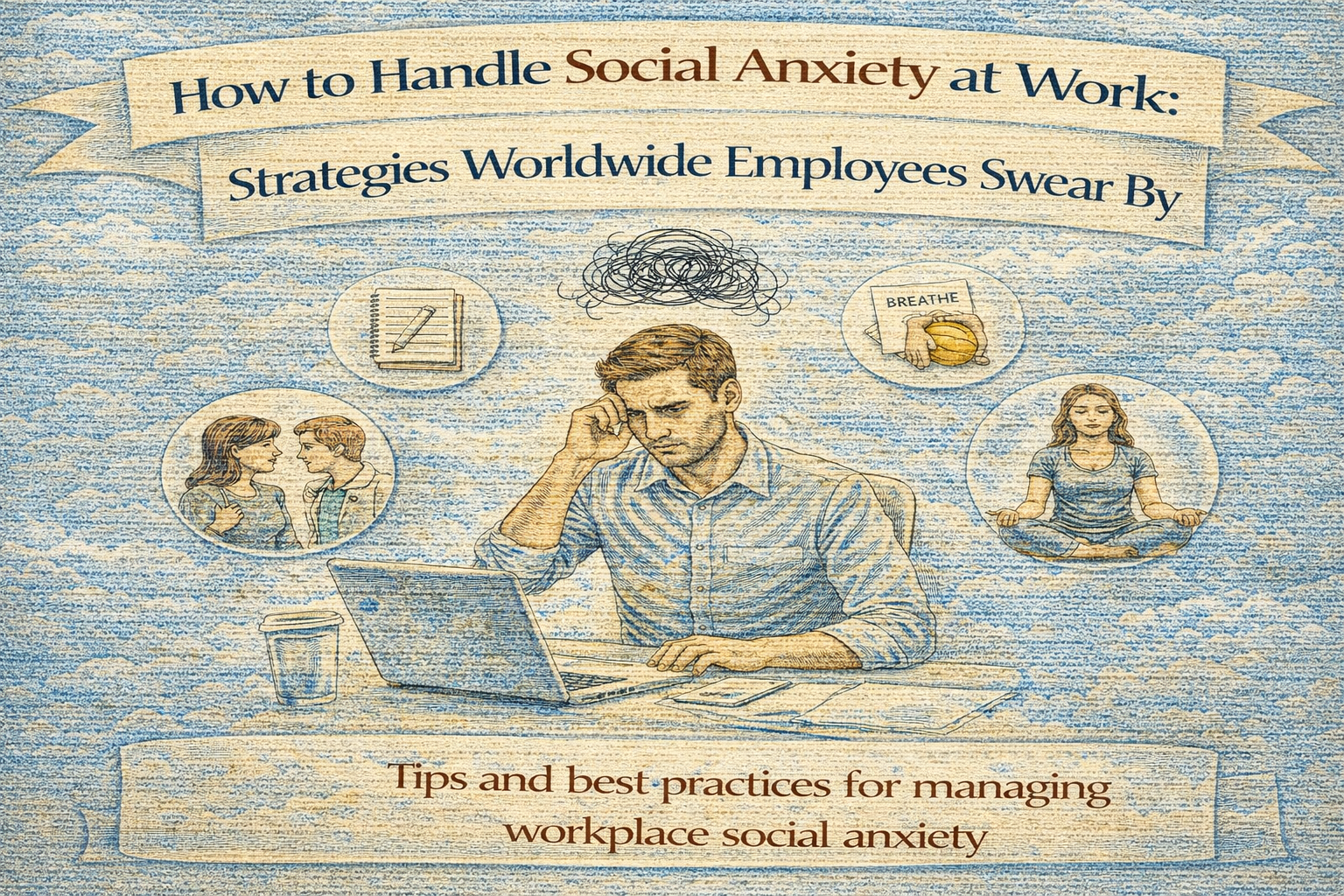
Step 1 — How to reduce social anxiety before work meetings starts the night before. Prepare two bullet points you want to contribute — no more. Rehearse them out loud once. On the day, arrive early, do 4-7-8 breathing (inhale 4, hold 7, exhale 8) for two minutes, and sip cold water. What to avoid: over-preparing every possible question or arriving late and rushing in.
Step 2 — How to deal with social anxiety during work presentations focuses on grounding. Plant your feet firmly, rest one hand on the table or podium, and speak to one friendly face at a time instead of the whole room. If your mind blanks, pause and say “Let me check my notes” — it’s normal and buys time. Expert tip: Many people find that labeling the feeling silently (“This is anxiety, not danger”) short-circuits the spiral.
Step 3 — Daily habits that reduce workplace anxiety include 10 minutes of progressive muscle relaxation each morning and a quick “wins log” at day’s end. Over time these habits lower baseline anxiety so meetings feel less threatening.
Expert Tips for How to Handle Social Anxiety at Work — What Professionals Recommend
Licensed clinical psychologists recommend practical, evidence-based tips that employees can implement without therapy. These strategies focus on what actually works in real offices.
Best employee strategies for social anxiety at work include scheduling “recovery time” after high-exposure events. A short walk or five minutes of quiet resets your nervous system.
Best apps for social anxiety at work reviews 2026 highlight three widely used options. Calm offers short workplace-specific meditations that many employees play on noise-cancelling headphones before calls. Headspace provides quick anxiety SOS sessions under three minutes. Sanvello combines mood tracking with CBT-based exercises — useful for spotting patterns across the week. Choose one and use it daily for two weeks to test fit.
Lifestyle changes professionals swear by involve protecting sleep and limiting caffeine on meeting-heavy days. Even modest improvements here can reduce symptom intensity noticeably.
Pro Tip: Record yourself giving a presentation once a month. Most people discover their performance looks far more confident than it feels — a powerful reality check.
Scientific Evidence & Research on How to Handle Social Anxiety at Work
Clinical research consistently shows that targeted strategies can reduce workplace social anxiety symptoms for most people. The National Institute of Mental Health confirms that social anxiety disorder is highly treatable.
Key Clinical Studies indicate strong results with cognitive behavioral approaches. A randomized controlled pilot trial published in Behaviour Research and Therapy found that work-related cognitive behavioral therapy helped employed individuals with social anxiety disorder improve occupational functioning.
Expert Opinions from researchers emphasize exposure combined with cognitive techniques. Peer-reviewed work on PubMed supports that even brief, focused interventions produce measurable gains in confidence and performance.
Statistical Data from the NIMH shows that 29.9% of adults with past-year social anxiety experience serious impairment. Yet the same research highlights that effective management dramatically improves career outcomes.
External links :
National Institute of Mental Health – Social Anxiety Disorder
Mayo Clinic – Social Anxiety Disorder
PubMed search for workplace CBT studies
Common Mistakes to Avoid When Learning How to Handle Social Anxiety at Work
Even motivated employees make these three mistakes. Recognizing them helps you move forward faster.
Mistake #1 — Ignoring physical symptoms and trying to “power through.” The body’s alarm system only gets louder. Better approach: acknowledge the symptom calmly (“Heart racing — normal anxiety response”) and use a quick grounding technique.
Mistake #2 — Avoiding all social situations at work. Total avoidance strengthens the fear. Better approach: start with low-stakes interactions (greeting one colleague) and gradually increase exposure.
Mistake #3 — Relying only on willpower. Willpower depletes quickly under stress. Better approach: pair intention with structured tools like the step-by-step guide above.
Frequently Asked Questions About How to Handle Social Anxiety at Work
Why do I have social anxiety only at work?
Workplace-specific social anxiety often stems from performance pressure and evaluation that doesn’t exist elsewhere. The fear centers on professional consequences rather than general socializing. According to clinical research, many people experience symptoms only in hierarchical or public-speaking settings. If symptoms interfere with your job, speaking with a healthcare provider can help identify tailored strategies.
Can you have social anxiety only at work?
Yes. Workplace triggers — meetings, presentations, networking — can activate symptoms while home and social life remain unaffected. This pattern is well-documented and responds well to targeted techniques focused on professional situations.
What are the best ways to manage social anxiety at work in 2026?
The most effective approaches combine breathing techniques before meetings, gradual exposure practice, and simple cognitive reframing. Employees report the strongest results when they use a consistent daily routine rather than searching for a single “cure.”
How long does it take to overcome social anxiety at work?
Many people notice meaningful improvement within 4–8 weeks of consistent practice. Full comfort can take 3–6 months, depending on severity and how regularly you apply the strategies. Progress is rarely linear — celebrate small wins along the way.
Are there apps that actually help with social anxiety at work?
Yes. Apps offering short guided breathing and mindfulness exercises (such as Calm, Headspace, and Sanvello) help many employees create calm quickly. Results vary, so test one for two weeks and track how you feel before and after work events.
Should I tell my boss about my social anxiety?
This is a personal decision. Some employees benefit from requesting reasonable accommodations under disability laws, while others prefer managing privately. If symptoms significantly affect performance, consulting HR or a mental health professional first can clarify options.
Conclusion — Take Control of How to Handle Social Anxiety at Work Today
You now understand exactly what social anxiety at work is, why it hits harder in professional settings, and — most importantly — how to handle social anxiety at work with proven, employee-tested strategies. The techniques in this guide have helped countless people move from dread to confidence in meetings and presentations.
Your next step is simple: pick just one technique from the step-by-step guide (most people start with the breathing exercise before their next meeting) and try it this week. Small, consistent action creates real change faster than waiting for motivation.